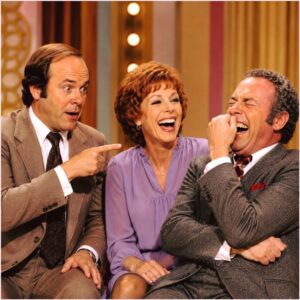
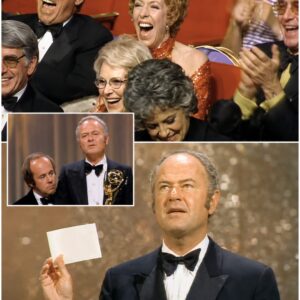
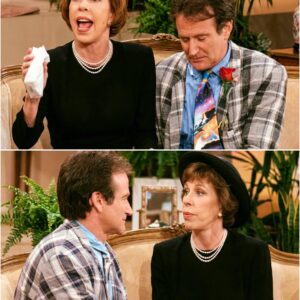
That night, live television slipped its leash when Carol Burnett and Tim Conway quietly abandoned the script and let chaos take over. What was meant to be a sharp, carefully timed sketch began to crack as Conway bent the rules—dragging out silences, leaning into absurdity, and stretching every beat until it snapped. Burnett struggled to keep her composure, the cast around her completely unraveled, and the audience erupted as the scene spun further off the rails. By the end, the script no longer mattered, the laughter couldn’t be contained, and a legendary TV moment was sealed—one of those rare explosions of comedy that only happens when true geniuses decide to ignore the rules entirely.

It began like a serious drama. Studio 33 went silent, the lights dimmed, and Carol Burnett — playing a self-important novelist — adjusted her scarf and faced her co-star with theatrical authority. Her character, the omnipotent Author, could control every move of her creation with a single word.

Enter Tim Conway, the “fictional” man she had written into existence — a mild-mannered character doomed to obey every line she typed. He stood there, confused, helpless… and already plotting mutiny.


What happened next was supposed to be a clever satire about a writer manipulating her characters. Instead, Conway turned it into open rebellion — a ten-minute comic breakdown so wild that even Carol Burnett herself couldn’t stay in character.

When the narrator (off-screen) commanded, “Rachel ran quickly — but hesitantly,” Carol followed, dramatizing every word like a soap-opera heroine caught in a storm. Then the narrator turned to Conway: “And her lover entered dramatically…”
Conway froze. Blinked once. Then shuffled in at the slowest, most awkward pace imaginable — one deliberate step every five seconds, his body language somewhere between a confused flamingo and a man stuck in invisible mud.


The audience was gone. Carol tried to keep going — lips quivering, voice cracking — but Conway doubled down. Every time the narrator described an emotion, he twisted it into a physical disaster: “He kissed her tenderly” became a near head-butt; “He embraced her passionately” turned into a bear hug from purgatory.
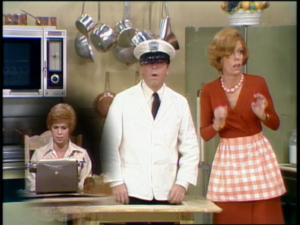
 

Burnett gasped between lines, whispering, “Stop it, Tim,” but he didn’t. He just kept escalating — rewiring the script, breaking the rhythm, and making the control room lose control.

By the midpoint, the entire scene had collapsed into glorious nonsense. Carol’s “powerful author” had lost all authority. Tim Conway was now the author, the editor, and the anarchist all in one. Every new instruction was a dare; every pause a trap.


And yet that was exactly why it worked. The Carol Burnett Show wasn’t just about scripted comedy — it was about watching brilliant performers gleefully destroy the script in real time. The moment Carol’s laughter broke, the studio erupted in applause. You could practically feel the cameramen shaking.

In the end, the scene wrapped with Carol clinging to her composure while Conway sauntered offstage, the triumphant survivor of his own fictional world. She looked at the audience and sighed: “And that, ladies and gentlemen, is why we don’t give him power.”

It remains one of the most perfectly derailed sketches in television history — a meta masterpiece about control that spun completely out of control. Because when Tim Conway steps into your story… the author never stands a chance.


Related Posts

He Said We Should Divorce. By the Time He Came Back, Everything Had Changed.

The Trip Once my husband left on a trip with his lover, he tossed over his shoulder, “Got a problem? Get a divorce.” So when he came…

Come join us — we booked a table!” my in-laws said happily. But the moment I walked into the restaurant, my heart dropped

The Dinner That Changed Everything The text message arrived at exactly 4:47 p.m. on an ordinary Tuesday afternoon, and looking back now, I should have known something…

Tim Conway’s legendary elephant story is going viral again—and for good reason. More than forty years later, it still lands with perfect timing. The moment he wandered off the script, you could feel the shift: the room tightening, the audience leaning in, and Tim calmly setting things in motion. It took just one small pause. Harvey Korman broke first. Carol Burnett couldn’t hold it together. Vicki Lawrence looked moments away from sliding out of her chair. Conway, meanwhile, stayed completely focused—steady, unbothered, delivering each line with quiet precision. By the time the punchline arrived, the studio was in full laughter mode, the cast had completely lost control, and Tim was barely catching his breath. Nothing felt forced. Nothing felt planned. It was pure instinct taking over. That’s why moments like this never fade. They aren’t built around big effects or clever tricks—they come from trust, timing, and performers who know exactly when to let things unfold naturally. It’s the kind of television that doesn’t age, because genuine laughter never does.

“IT’S HARD TO WALK WITH DIGNITY.” Saturday night. One TV in the house. Everyone gathered like it was an event — because it was. The Sydney Opera House appeared on screen looking elegant and untouchable… and within minutes, Tim Conway turned it into the stage for perfectly unplanned chaos. Tim didn’t chase the joke. He inhabited it. He walked into it slowly. Painfully. As if gravity itself had a personal grudge against him. Carol Burnett fought to stay professional — truly fought — but Tim treated professionalism like a polite suggestion. One pause. One innocent glance. And suddenly the cast was gasping for air. This wasn’t scripted funny. This was “we might not survive this scene” funny. The kind where the audience laughs harder because the performers are losing control right in front of them. Harvey Korman starts shaking. Carol bends over, defeated. Tim just stands there, baffled, like he’s only trying to be helpful.

It was supposed to be a normal night in the Bunker house… until Edith came home from jury duty with something Archie Bunker had never faced before: legal authority 😂⚖️ In this classic moment from All in the Family, Edith proudly declares, “I ain’t at liberty to discuss it,” and Archie absolutely short-circuits on the spot. The more he demands details, the calmer Edith becomes — following the judge’s orders while Archie spirals louder and louder. Watching Carroll O’Connor try not to break as Jean Stapleton gently stonewalls him is pure sitcom gold. For once, Edith isn’t the confused one — she’s the most powerful person in the room, and Archie can’t yell his way out of it. It’s quiet, brutal, and unbelievably funny

It was supposed to be a normal night in the Bunker house… until Edith came home from jury duty with something Archie Bunker had never faced before:…

The second Tim Conway stepped into that scene, you could already feel it coming. That slow walk, the squint, the pauses that stretched just a little too long — it was like watching a setup you knew was about to explode. And right there next to him, Harvey is doing everything he can to hold it together… and failing spectacularly. The outlaw’s already cracking, the room starts to shake with laughter, and Conway just keeps pushing it further — slower, quieter, more ridiculous with every second. That’s what made it magic. No rush, no noise — just perfect timing and the kind of control that turns silence into chaos. By the end, nobody’s in character anymore. Not Harvey. Not the cast. Not even the audience. Just pure, unstoppable laughter.

Leave a Reply

Your email address will not be published. Required fields are marked *